


Printing certified hi-vis to EN ISO 20471
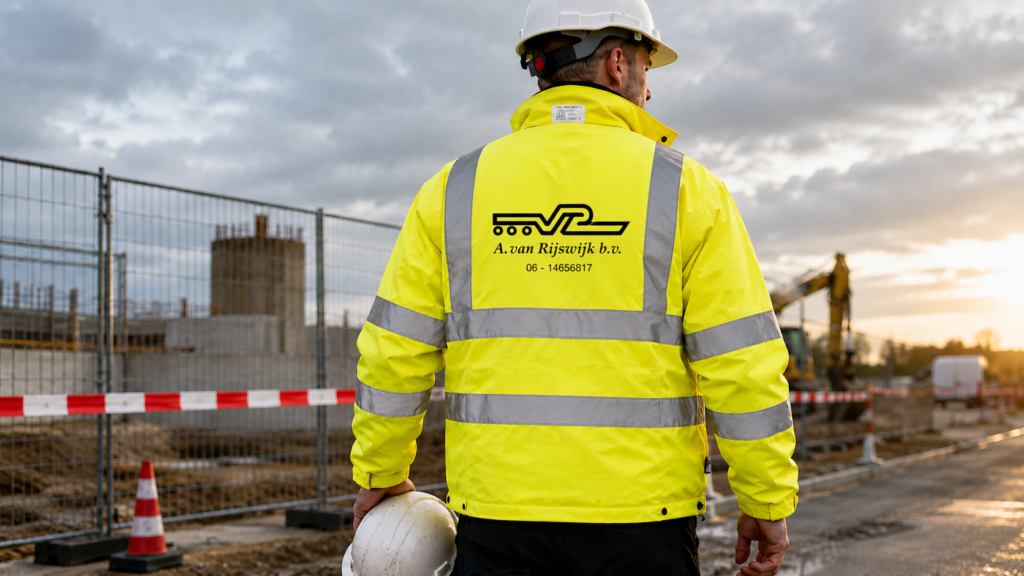
Hi-vis workwear must meet strict requirements: sufficient fluorescent surface area, correct reflectivity and colour fastness after washing. We supply certified hi-vis to EN ISO 20471 (class 1, 2 or 3) from brands such as Blåkläder, and print it using materials and in positions that respect the standard.
When is hi-vis mandatory?
Hi-vis to EN ISO 20471 is mandatory for work involving traffic or vehicle risk, or in low-visibility environments: road workers, earthmoving alongside roads, railway maintenance, emergency services, traffic controllers and landscaping work on or beside municipal land. The employer must provide PPE where the risk cannot be eliminated in another way.
The standard has three classes, based on how much fluorescent material and reflectivity the garment has. See the overview below.
The three EN ISO 20471 classes in brief
| Class | What it is | Typical for |
|---|---|---|
| 1 | Smallest area of fluo and reflectivity (e.g. a light waistcoat). | Low-risk environment, car parks, warehouse. |
| 2 | Medium-sized area (e.g. polo or jacket). | Work along ordinary roads, municipal work, landscapers. |
| 3 | Largest area (trousers and top together, or coveralls). | Motorway, railway, poor visibility, high-risk work. |
Which class you need depends on your type of work and environment. We advise based on what the law requires, no more.
Printing while retaining certification
Incorrect printing can drop a garment from class 3 to class 2 — or invalidate the certification entirely. On every project we stick to the rules of the standard:
- No printing over reflective strips.
- Keeping sufficient fluorescent surface area clear.
- Using certified transfers and inks that are colour- and wash-fast.
- Printing in positions that respect the standard (chest, sleeve, lower back).
- On request we supply a certification statement for the client, municipality or tender.
What we supply
- Certified hi-vis (EN ISO 20471) class 1, 2 and 3 from Blåkläder.
- Work trousers, polos, T-shirts, softshells, jackets and rainwear in fluo yellow or fluo orange.
- Printing and embroidery while retaining the classification.
- Logo, name and job title in standard-compliant positions.