


Supplying files & textiles, everything you need to know
A good print starts with good file delivery. On this page you’ll read how to supply your design file, and when and how you can supply textiles yourself, including the intake form we use for that.
Supplying files
Which file formats?
We prefer to work with vector files: Illustrator AI or EPS. With these we can print any size without loss of quality and colour management is straightforward.
Workable formats in order of preference:
- AI or EPS, vector, ideal
- PDF, vector if built that way
- PSD, Photoshop, at actual size and 300 DPI
- TIFF, high-resolution raster
- JPG, only at actual size and 300 DPI
Resolution and size
- Photos: at least 300 DPI at actual size
- Vector: scalable, no DPI debate
- EPS is no guarantee of vector. Many EPS files contain only an embedded JPG or PNG. Open the file and check whether it consists of lines and shapes, not pixels.
- Don't do this: upscaling a 72 DPI internet image to 300 DPI in Photoshop. That gives a blurry result.
Colours, Pantone is decisive
For screen printing we always work with Pantone (PMS). Provide PMS codes in your file or in the email. Example: "Logo in PMS 2945C, background PMS 021C".
RGB, HEX, CMYK and RAL colours are, for screen printing, always converted to the nearest Pantone colour and may therefore differ from what you see on your screen. RGB is a screen colour and has a different colour range than a Pantone ink; a perfect match is therefore impossible.
No PMS codes? Then describe the colour as precisely as possible: "apple green", "emerald green", "warm red (not orange-red)". If in doubt we'll make a proof.
Points of attention per technique
Screen printing, For each print colour we make a separate screen printing frame. More colours or print positions = more set-up and printing costs. Gradients are printed as halftones.
DTF transfer, Full-colour is no problem. Photos are allowed, provided they're supplied sharp.
Embroidery, We convert your design into an embroidery file (DST/EMB). For the best embroidery result: avoid very fine detail (smaller than 3 mm), use no more than 6-8 colours, and keep distance between elements.
Sublimation, Only works on 100% polyester and light colours. Photo quality is possible.
Specialty inks, Reflective, glow-in-the-dark, glitter and puff are always spot-colour work — no gradients, no halftones, one colour per ink. Indicate with your request which effect you want.
How do you send your file?
- By email to verkoop@visualprint.nl, state the project or company in the subject line
- Large files (>10 MB) via WeTransfer or similar services
- Cloud shares (Dropbox, Google Drive) are fine too, just make sure download rights are enabled
Common mistakes
- × Supplying a JPG as a “vector”. JPG is always raster.
- × Upscaling a 72 DPI image from a website to 300 DPI. The result stays blurry.
- × Only RGB or HEX colour values without a PMS code. For screen printing we always translate to Pantone — so provide that code.
- × Fonts not in outlines (letter contours). If we don't have that font, your text will come out slightly different.
- × A print designed across a side seam. We can't do that — choose a different position or a seamless T-shirt.
Need help with the design?
No design, or a sketch on paper? We have our own designer who can help you, ask about it with your quote. From € 60 for logo work up to complete tailor-made merchandise designs.
Maximum print sizes per position (printing)
The sizes below apply to printing (screen printing, DTF, sublimation) and are indicative for your design. Exact dimensions may vary slightly per textile brand and garment — if in doubt we advise per project. For embroidery the maximum dimensions are lower (see the embroidery).
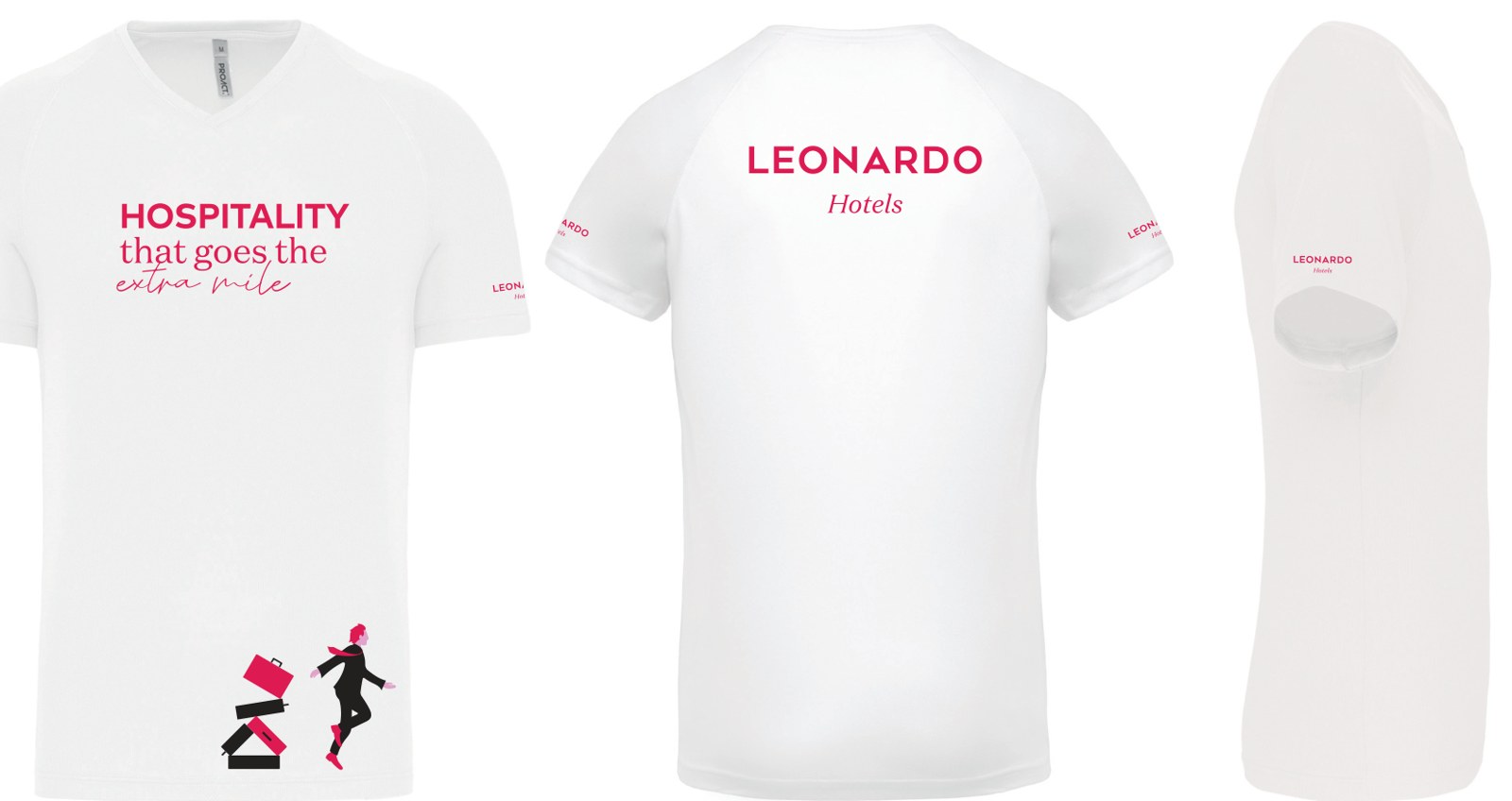
| Position | Adult | Children |
|---|---|---|
| Front | 30 × 40 cm | 20 × 20 cm |
| Front XL | 38 × 50 cm | — |
| Back | 30 × 40 cm | 20 × 20 cm |
| Back XL | 38 × 50 cm | — |
| Chest logo | 10 × 10 cm | 7 × 7 cm |
| Pocket logo | 8 × 8 cm | — |
| Short sleeve | 10 × 8 cm | 6 × 5 cm |
| Long sleeve | 10 × 35 cm | — |
| Right side | 30 × 30 cm | 20 × 20 cm |
| Left side | 30 × 30 cm | 20 × 20 cm |
| Neck label back | 6 × 4 cm | 6 × 4 cm |
| Bottom label | 6 × 4 cm | 6 × 4 cm |
For hoods, trouser legs and non-standard positions: send us your requirement, and we'll advise on what fits the specific garment.
Supplying textiles
Our main rule: we supply the textiles
In almost all cases we supply the textiles ourselves. We have access to virtually every major textile brand, Stanley/Stella, B&C, Bella+Canvas, Fruit of the Loom, Gildan, AS Colour, Blåkläder, and more.
Why we do it this way:
Quality and adhesion guarantee, we know exactly what we're getting. Inks, embroidery and transfers are tested on the textiles we supply. No surprises.
No hidden costs, with a total quote (textile + decoration) you have one price and one supplier. No hassle with double orders, delays or wrong sizes.
One responsibility, if something isn't right, it's our problem to solve. With shared delivery that becomes more complicated.
When can you supply textiles yourself?
By agreement, in specific exceptions:
- Sports clubs with their own brand supplier, e.g. a specific shirt model from a sportswear brand that we can't supply
- Private brands / private label, if you have your own product line and use specific blanks that we don't carry (see also our private label page)
- Niche items, historical jackets, theatrical costumes, restorations, and other special items
- Brands we can't supply, e.g. exclusive fashion brands with direct distribution
What we can't guarantee
With your own supplied textiles we can't give an unconditional adhesion guarantee. We always do a test first:
Should the test show that the print doesn't adhere well (because the fabric has, for example, an anti-stain coating), we'll advise an alternative technique or decline the job. Better honest than a box of prints that are peeling off.
- Sample print on one piece from your delivery
- Wash test, at least 1 wash at 40°C, then a check of adhesion and colour
- Approval from you, only then does the bulk go into production
What we ALWAYS need, the intake form
For every own-supplied textile project we need this information before we can prepare a quote:
1. Per item model
2. Treatments, extremely important
Much clothing is factory-treated with chemical coatings that block the adhesion of inks or transfers. Indicate for each item:
3. Photos
- Brand name and item code (e.g. "B&C Heavy T 190g, art. TU01T")
- Composition (% cotton / polyester / elastane / wool / etc.)
- Maximum wash temperature (according to the label)
- Number of pieces per size (XS / S / M / L / XL / XXL / XXXL)
- Number of pieces per colour (black / white / navy / etc.)
- Water-repellent coating (e.g. Teflon, PFAS, fluorocarbon), yes / no / don't know
- Silicone treatment, yes / no / don't know
- Anti-stain treatment, yes / no / don't know
- Flame-retardant (FR-treated), yes / no / don't know
- Anti-bacterial or antimicrobial, yes / no / don't know
- Previously printed or embroidered on the desired position, yes / no
- Photo of the inside label (so we can read the composition and wash instructions)
- Photo of the spot to be printed (to check for previous prints, seams, or texture)
Liability with own delivery
When you supply textiles yourself, the following applies:
- We don't make a test print in advance unless this has been explicitly agreed.
- We assess the textile based on the information you provide (composition, coatings, previous use).
- Should it turn out after production that the print doesn't adhere well due to properties of the fabric that we couldn't determine in advance, we cannot be held liable for reproduction.
- We always help think of a solution: alternative technique, different position, or reprinting the batch at material cost.
Ready to start your order?
File ready and clear about the textile? Request a quote.